Proof and Audit an EDP-driven Email Campaign
Proofing
Proofing refers to the process of sending test versions, called "proofs," of the email message to a designated recipient, or set of recipients. Proofs are used to check for accuracy in grammar, content, format, and appearance, and to verify that personalization and Dynamic Content is correctly populated.
For Email Campaigns that use the Engagement Data Platform (EDP) as the data source, the platform supports the use of Quick Proofs. Quick Proofs allow you to either manually enter an ad-hoc list of intended proof recipients or to define a reusable Quick Proofing Group containing one or more proof recipients
Important: The use of Standard Proofs is not supported in EDP-driven Campaigns.
Quick Proofs
The Quick Proof feature is accessible from two different places in the Campaign screen: the Review button and the Preview window. The functionality is largely the same between the two, with a few notable differences, described below:
1. Send Quick Proofs (Review button)
1. Navigate to the Campaign.
2. Click the Review button.
3. Within the Proofing and Auditing section, select the desired format version: HTML or Plain Text.
4. In the Send Proof To field, either:
- Enter one or more email addresses, or
- Click the browse icon to pick a Quick Proofing Group.
5. The Dynamic Content Selector is populated with a tree diagram showing all of the Dynamic Blocks and rules. Place a check mark next to the Dynamic Content variants that you want to test
Note: The Proof Count field indicates how many proofs will be sent to each recipient. The system imposes a hard limit of 250 proofs to each recipient. If you surpass this threshold, you must reduce the number of selected Dynamic Content variants in order to decrease the Proof Count
6. Click Send Quick Proof.
2. Send Quick Proofs (Preview window)
1. Navigate to the Campaign.
2. Click Preview in the Tool Bar.
3. Optionally select the Personalization tab. Either:
- Enter the desired personalization values that you want to include in the proof message.
- Or, enter an email address in the Email Record Lookup field; the platform will populate any Personalization Fields using values pulled from this record.
Note: The ability to specify personalization values is unique to the Quick Proof method available in the Preview window.
4. Optionally select the Dynamic Content tab. Check the Dynamic Content variant(s) that you want to use in the proof message.
5. Select the Review tab.
6. In your Email field, either:
- Enter one or more email addresses.
- Or, click Add emails from Proof group to pick a Quick Proofing Group.
7. In the Subject Prefix field, enter a text string. This value will be inserted in front of the subject line of the proof message.
8. Click Send Proof.
Auditing
Audits are used to verify the number of recipients in the Campaign audience, after factoring in blank or invalid email addresses, opt-outs, etc. If you have Dynamic Content in the Campaign, the audit results will break out the number of recipients who will receive each Dynamic Content variant.
3. View pre-launch audits
1. Navigate to the Campaign and select the Review button.
2. Within the Proofing and Auditing section, the audit chart is displayed in the following situations:
- You selected Member Record as the Audience.
- You selected a Campaign-ready File, and you applied an Audience to the file.
- You selected a Campaign-ready File, but did not apply an Audience to the file contents.
The audit chart shows the following counts if you selected Member Record:
- Total Population (database size)
- Segment Count (selected Segment count before any suppressions, such as opt-outs and invalid emails, are applied)
- Mailable Count (total count after suppressions are applied)
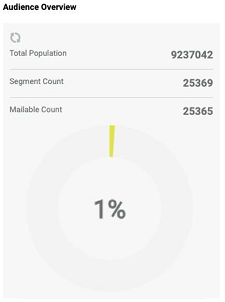
The graph depicts the percentage of the total population that is mailable (Mailable Count / Total Population).
The audit chart shows the following counts if you selected a Campaign-ready File:
- List Size (number of records in the file)
- Mailable Count (total count after suppressions are applied)
The graph depicts the percentage of the total population that is mailable (Mailable Count / List Size). You can refresh the counts in the audit chart by clicking the Refresh button.