Email Multi-Campaign Dashboard
Real time analytics provide marketers with the ability to measure and review what is currently happening with their email campaigns. Data is shown in real time and the dashboards include consolidated multi-campaign as well as single-campaign reports.
The Email multi-campaign dashboards provide statistics across all campaigns within your Email channel. You can also use the links within these dashboard reports for a more detailed view per individual campaign.
Our Real time analytics user guide outlines the general functionality that is available within these screens, such as applying filters, sharing, and exporting your data.
Reports
Each dashboard provides insights on engagement, delivery, location based stats and link activity, depending on the reports available.
The reports are divided into sections, which group related metrics, and charts, to allow you to visualize performance data.
The Email dashboard includes the following seven types of reports:
- Engagement
- Conversions
- Delivery
- Links
- Geography
- Audience
- Realtime

Engagement report
The Engagement report provides marketers with insights on how well their campaigns are doing and if they are creating engagement; are your emails reaching the intended audience, are customers opening your emails, and are they engaged with your content? Are they clicking through?
Use the different data sets within this dashboard to discover how your audience are engaging with your campaigns.
The KPI Summary report provides general KPI over all campaigns, such as:
- Messages sent — how many messages were sent out
- Messages delivered — how many of the messages sent, have actually been delivered.
- Projected percentage of messages opened — how many of the delivered messages have been opened. This is the unique human open rate as a percentage of recipients whose opens or non-opens would be visible. This means recipients using Apple MPP are excluded from the open rate.
- Percentage of messages clicked — how many of the delivered messages have been clicked by unique humans. Non-human clicks are not included.
- Percentage of opt-outs — how many of the delivered messages resulted in an opt-out
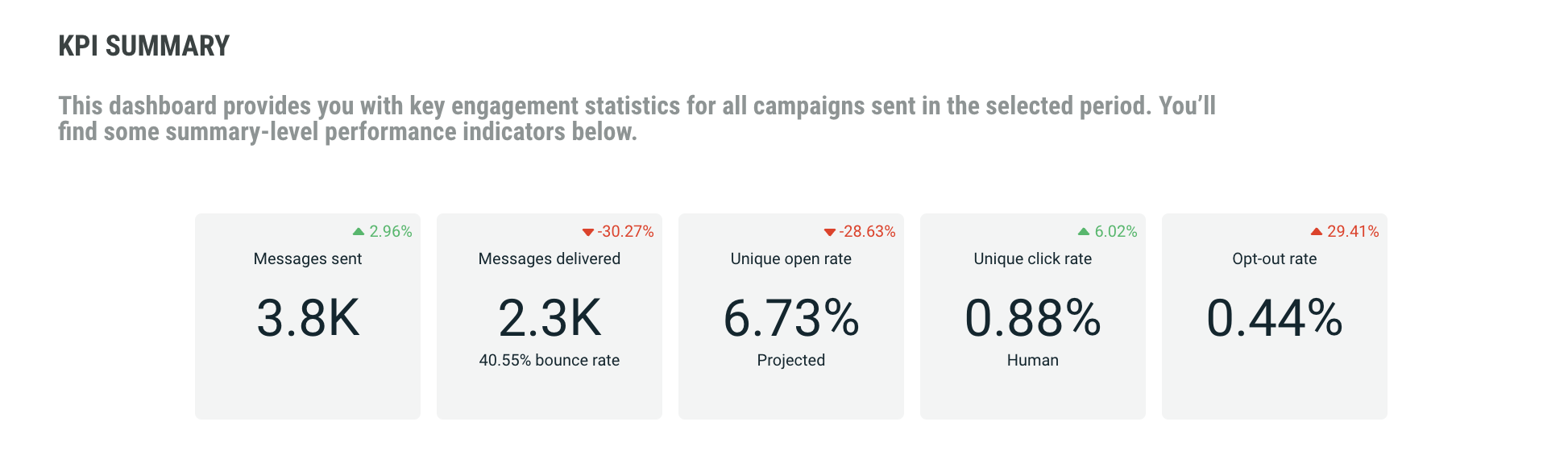
Note: If you collect revenue data and the Conversion report is active within your email dashboard, your KPIs will include a tile displaying Total Revenue instead of the Opt-out rate.
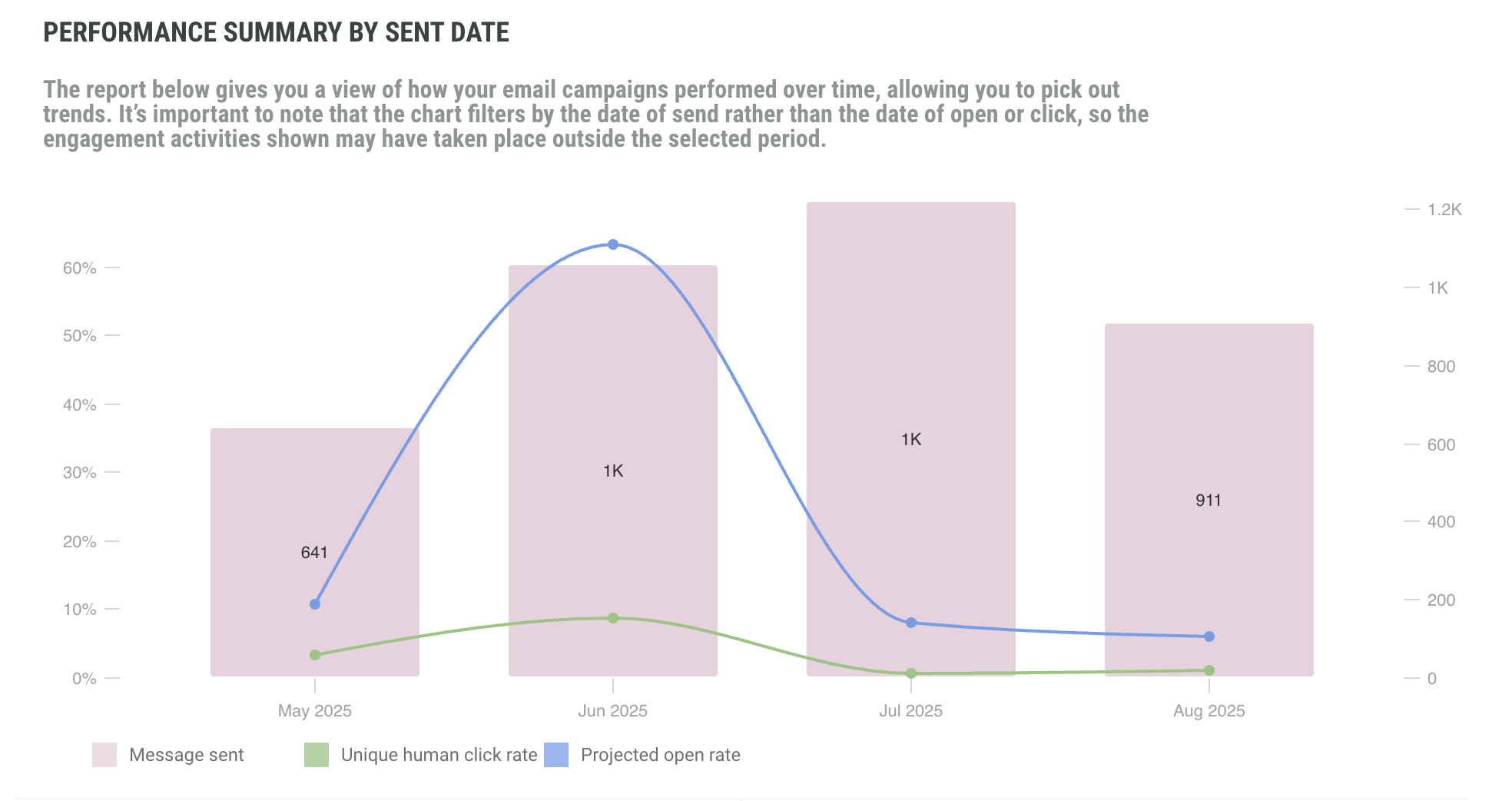
The Engagement dashboard also provides performance summary by sent date, highlighting number of human clicks and comparing it to your projected open rate. The time line is based on the selected filter.
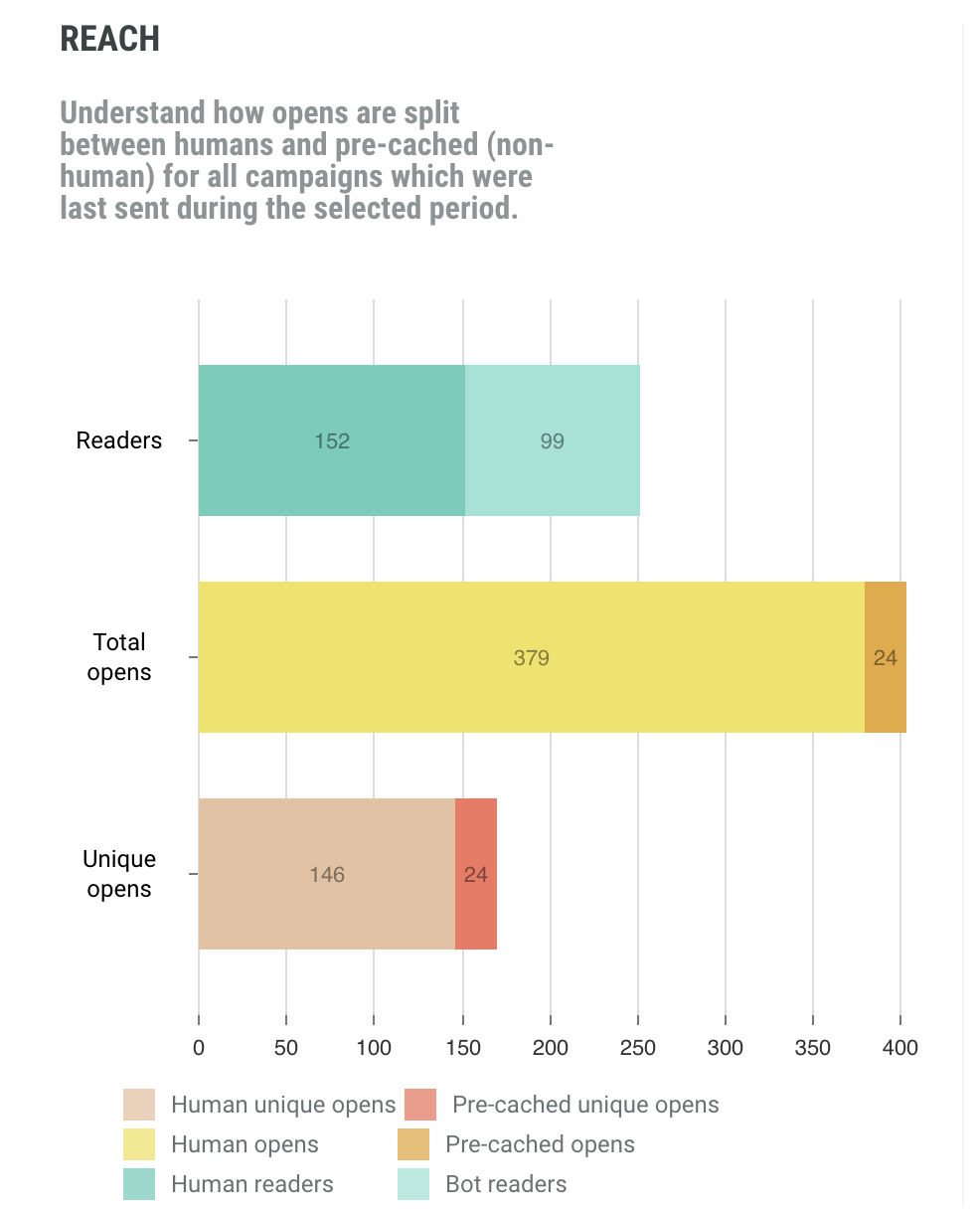
The Reach report is a comparison between total opens vs unique opens, as well as human vs pre-cached opens. A pre-cached open is a false open by Apple MPP.
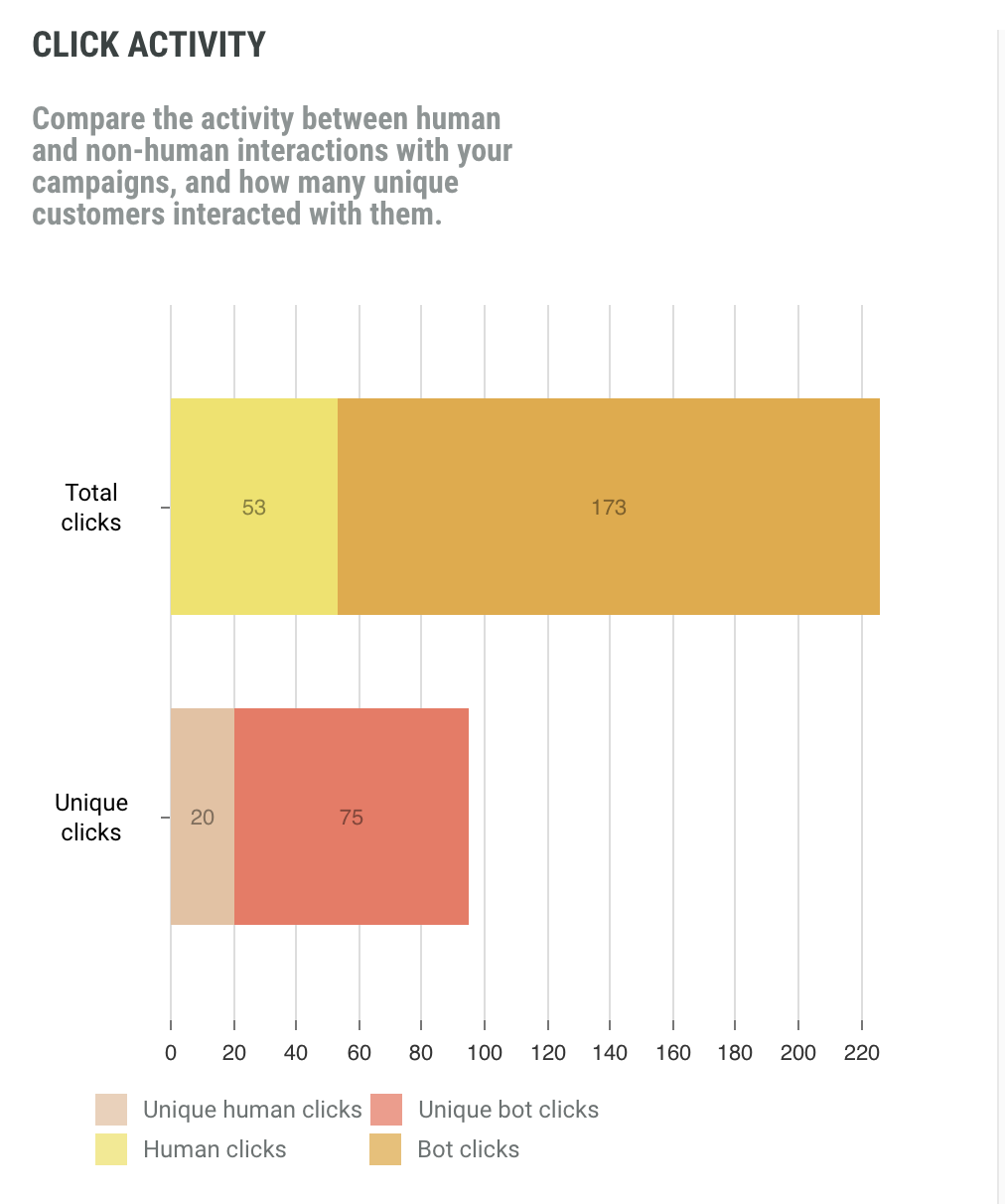
The Click Activity report compares human and non-human interactions (clicks) as well as unique vs total clicks.
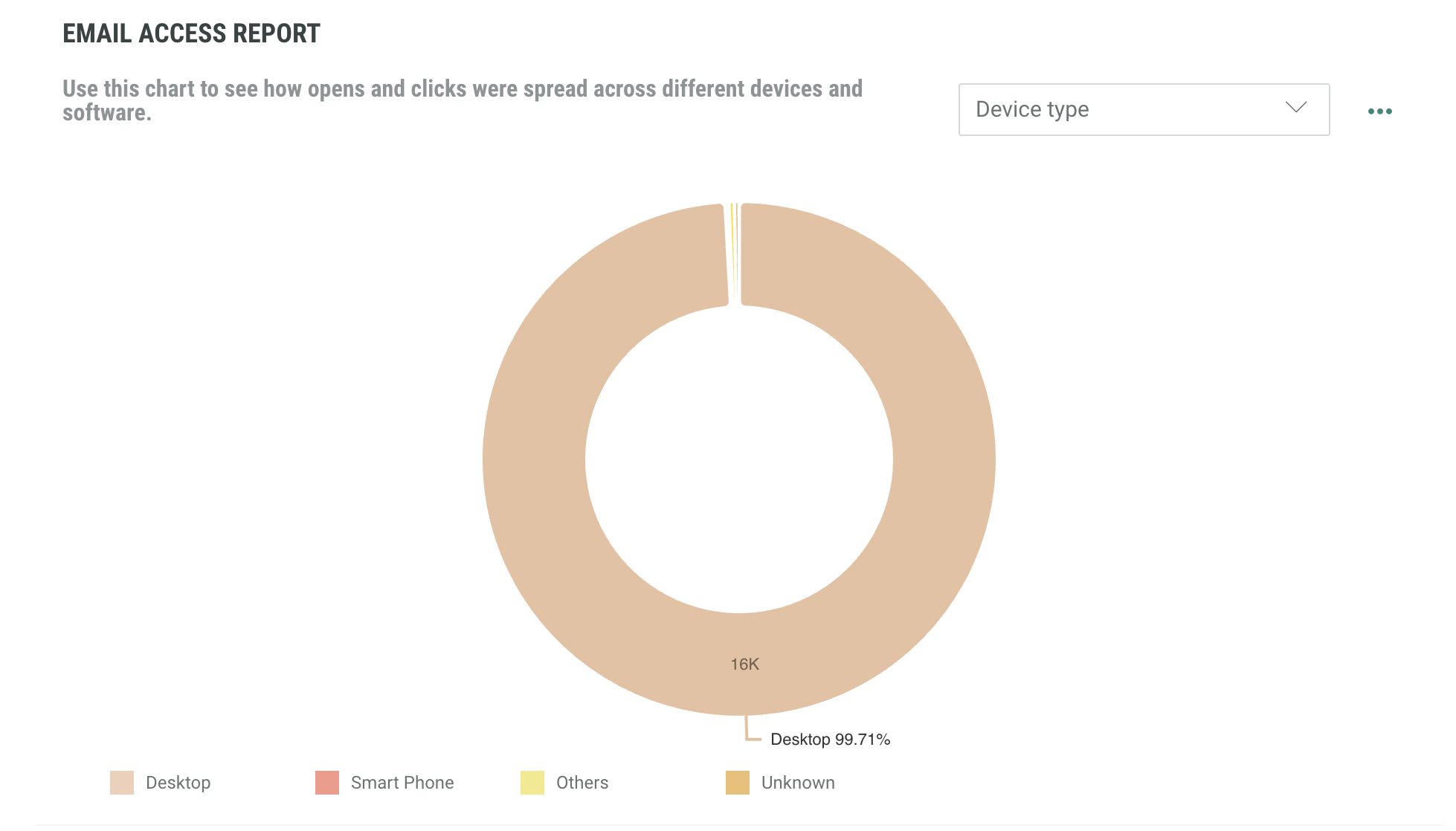
The Email Access Report shows how opens and clicks were spread across different devices and software. Select the data you wish to view using the drop down menu and the toggle on the right hand side.
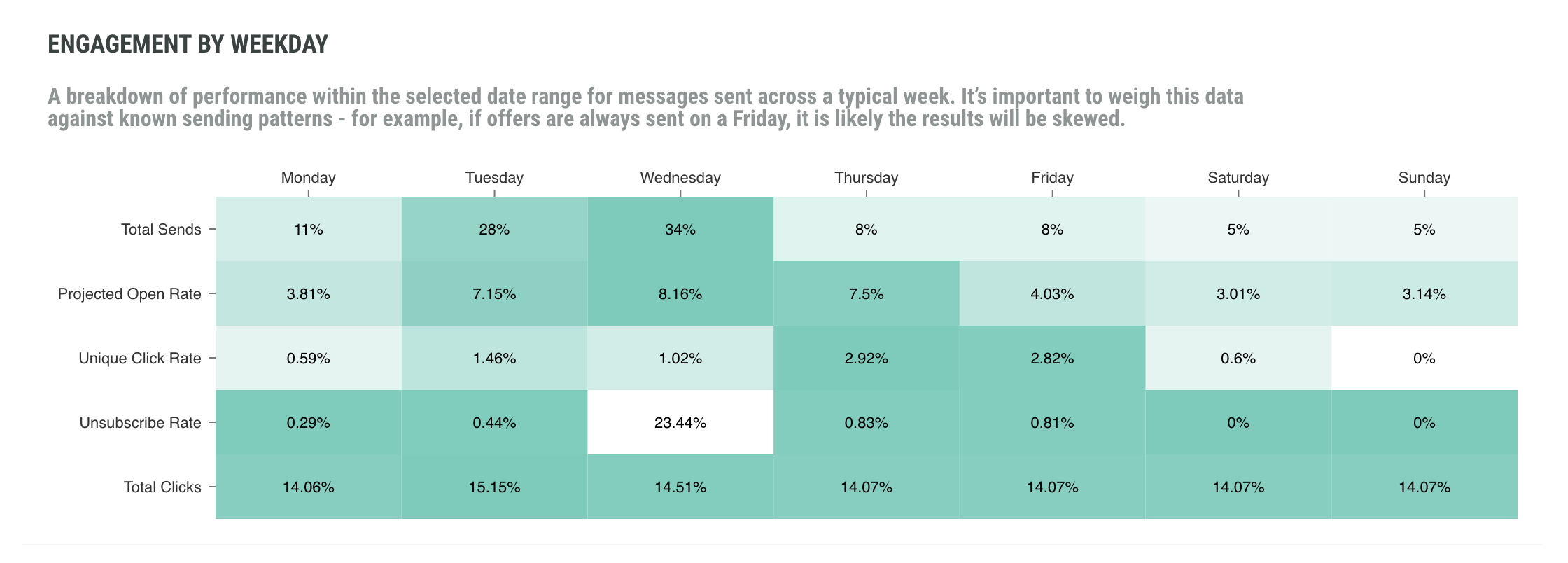
The Engagement by Weekday report shows breakdown of performance within the selected date range for messages sent across a typical week. This heatmap shows data for each day of the week and contains the following metrics:
- Total sends: the proportion of total sends across the week as a percentage
- Projected open rate: unique open rate for emails sent within the selected period, adjusted to account for pre-cached opens
- Unique click rate: unique click rate for emails sent within the selected period after filtering out bots
- Unsubscribe rate: percentage of recipients who unsubscribed after receiving an email on this day
- Total clicks: the proportion of total clicks across the selected period
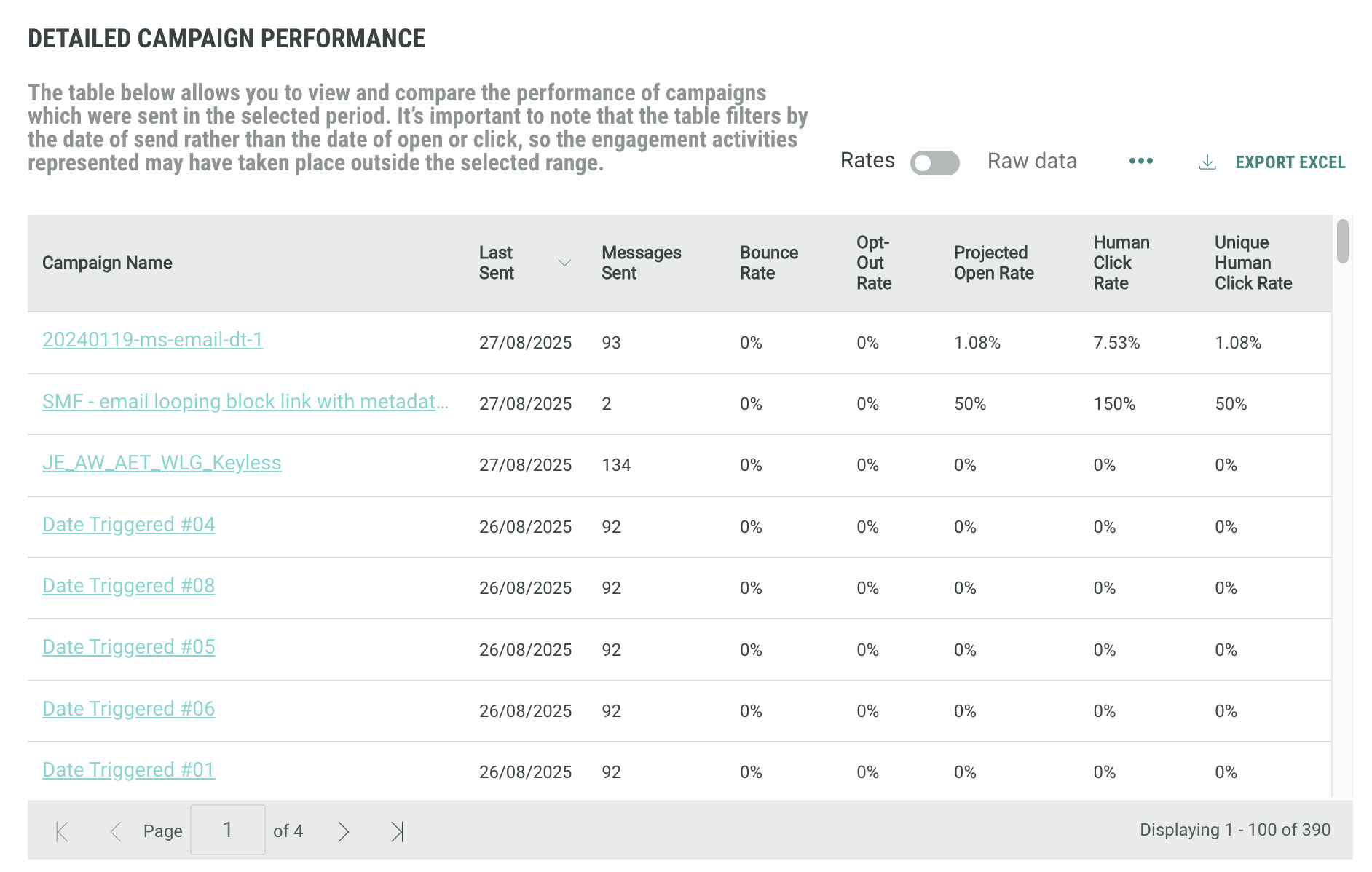
Lastly, you can also find an overview of performance statistics per individual campaign in the detailed campaign performance. Details available are:
- Last sent date
- Total number of messages sent
- Percentage of sent messages that bounced
- Percentage of delivered messages that resulted in an unsubscribe
- Percentage of delivered messages that were opened. This includes human and non-human opens
- Projected percentage of messages that are opened. This is the unique human open rate as a percentage of recipients whose opens or non-opens would be visible. This means recipients using Apple MPP are excluded from the open rate.
- Percentage of delivered messages that were clicked by a human
- Percentage of delivered messages that were clicked by a unique human
You can switch between viewing the Rates or the Raw data using the toggle on the right hand side.
Conversions report
The Conversion report is designed to give marketers clear, campaign-level insight into how their messaging drives revenue outcomes. This report aims to provide foundational revenue reporting across email, SMS, and push campaigns, all tied to attributed purchase data.
Note: to view this report, you must have the following configured by our Tech Services team:
- Web events
- Event mapping with associated e-commerce purchase data
- Up to 2 years of purchase data
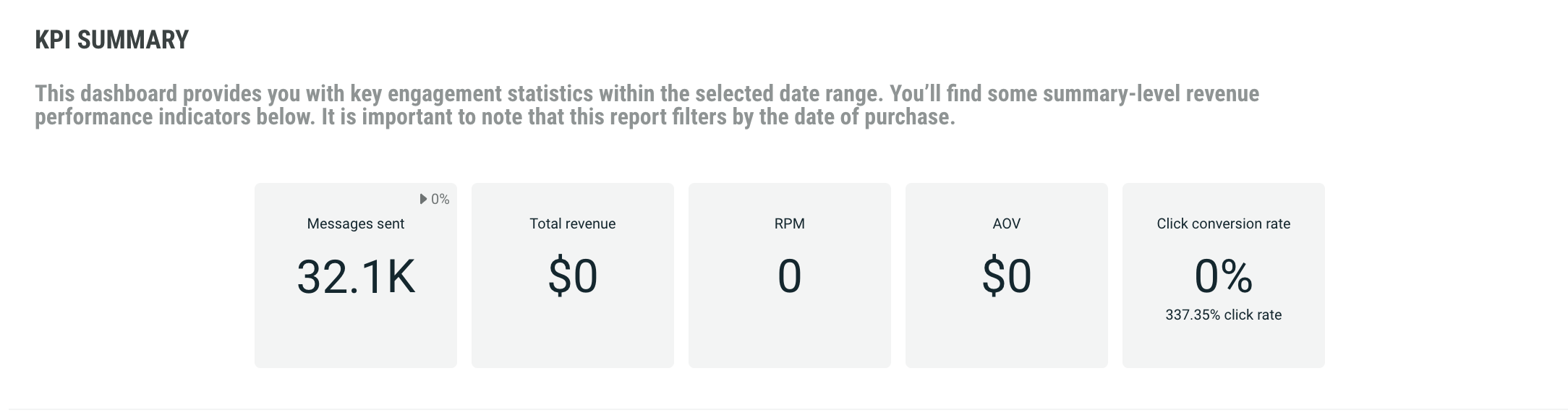
The Conversions report KPI Summary provides you with key engagement statistics within the selected date range, including some summary-level revenue performance indicators such as:
- Messages Sent: Number of messages sent
- Total Revenue: The total of all purchases made in the selected time frame, not considering returns
- RPM: Revenue per mille (RPM) shows how much revenue you generate per 1,000 emails sent
- AOV: Average order value
- Conversion Rate: the percentage of delivered messages which resulted in one or more conversion events (e.g. ecommerce purchases). A single user may generate multiple conversions if they purchase more than once.
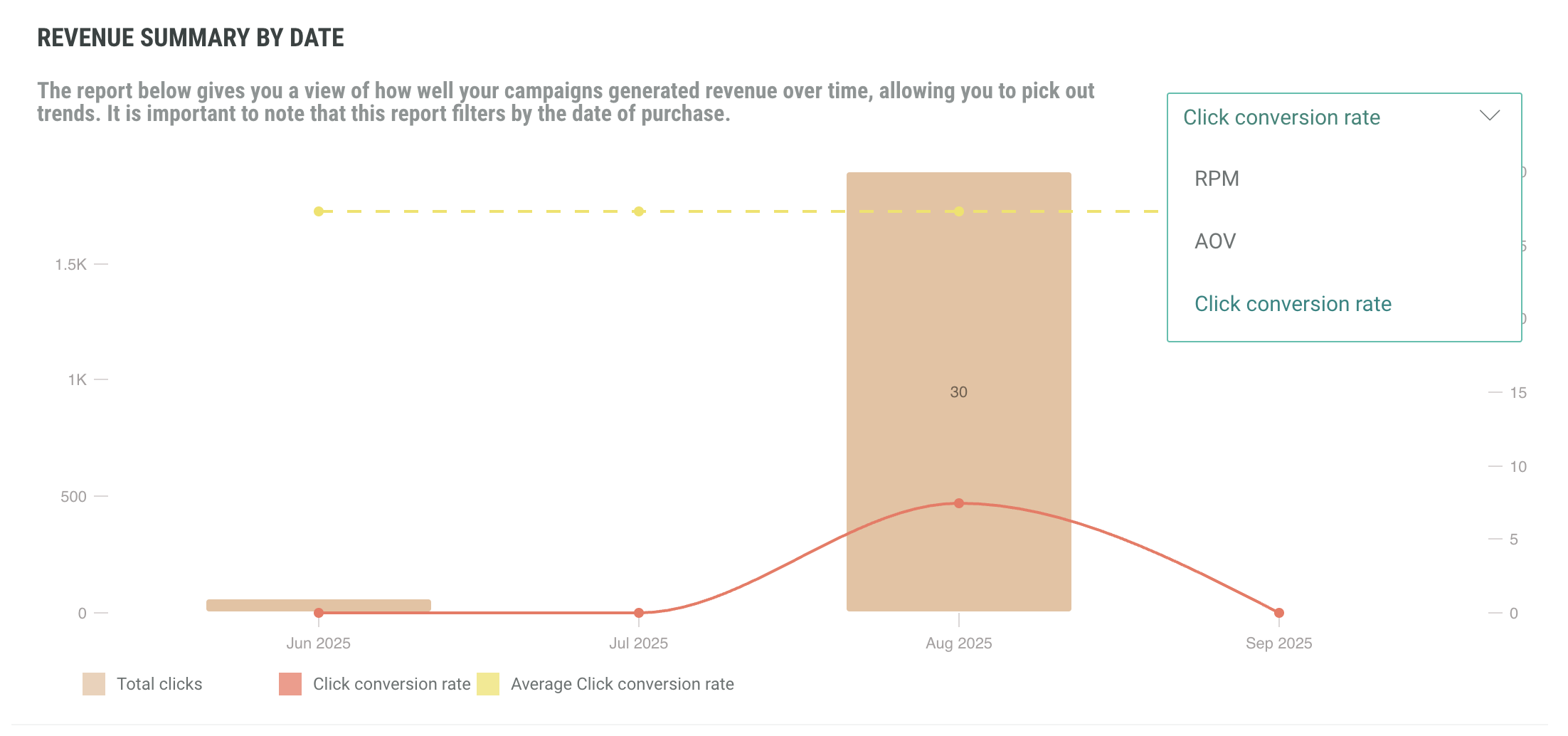
The Revenue Summary by Date graph provides a view of how well your Campaigns generated revenue over time, allowing you to pick out trends and identify the success of different Campaigns over different periods of time. Use the dropdown to select from RPM, AOV, or Click Conversion Rate to be displayed on the graph.
The Detailed Campaign Performance table allows you to view and compare the performance of Campaigns sent during the defined time period. You can find the following data within this table:
- Last sent: Date of last send if the campaign was sent multiple times
- Messages sent: A sum of all messages sent within the selected date range
- Cumulative total revenue: The total of all purchases made up to, and including, the selected date range.
- RPM: Revenue per mille (RPM) shows how much revenue you generate per 1,000 emails sent
- AOV: Average order value (AOV) = total revenue / number of ecommerce_purchase events
- Total Conversions: all completed conversion events attributed to the campaign. For ecommerce, this typically means purchases. A single customer who has made multiple transactions will have registered multiple conversions.
- Unique Click Rate: proportion of recipients who went on to click the email, without accounting for bots
- Conversion Rate: the percentage of delivered messages which resulted in one or more conversion events (e.g. ecommerce purchases). A single user may generate multiple conversions if they purchase more than once.
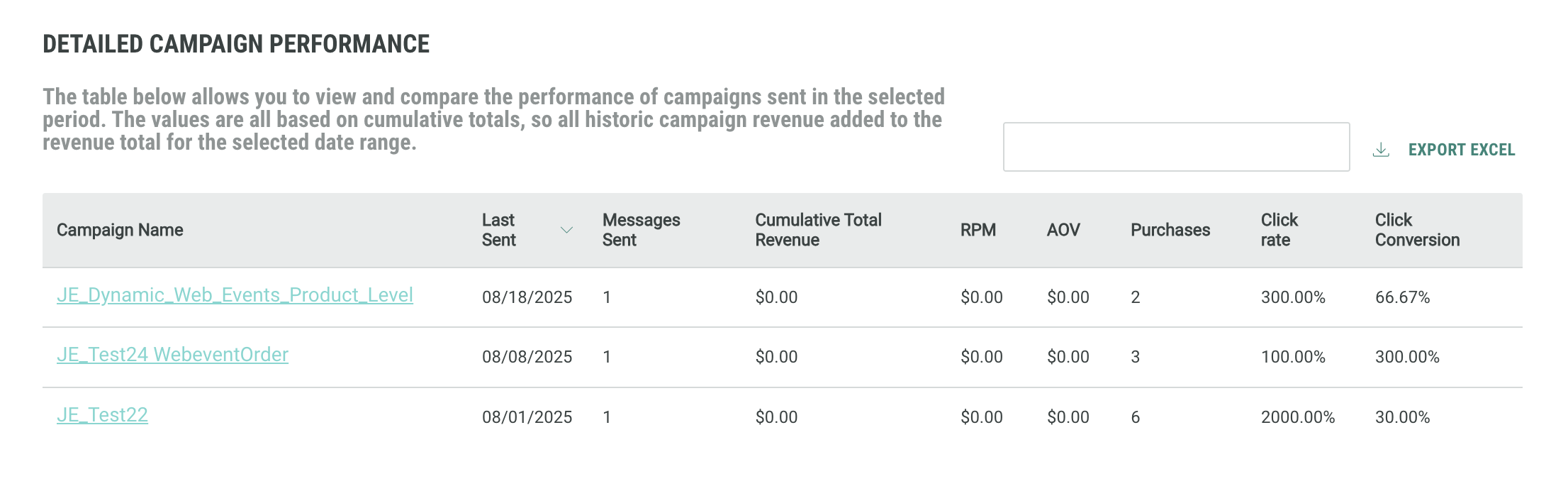
Note: Use the search bar next to the Export Excel button to search for specific Campaigns
Delivery report
The Delivery report tells marketers if their messages are reaching the inbox and how many don't get delivered because of spam complaints, opt-outs or other bounce reasons (such as bad email addresses).
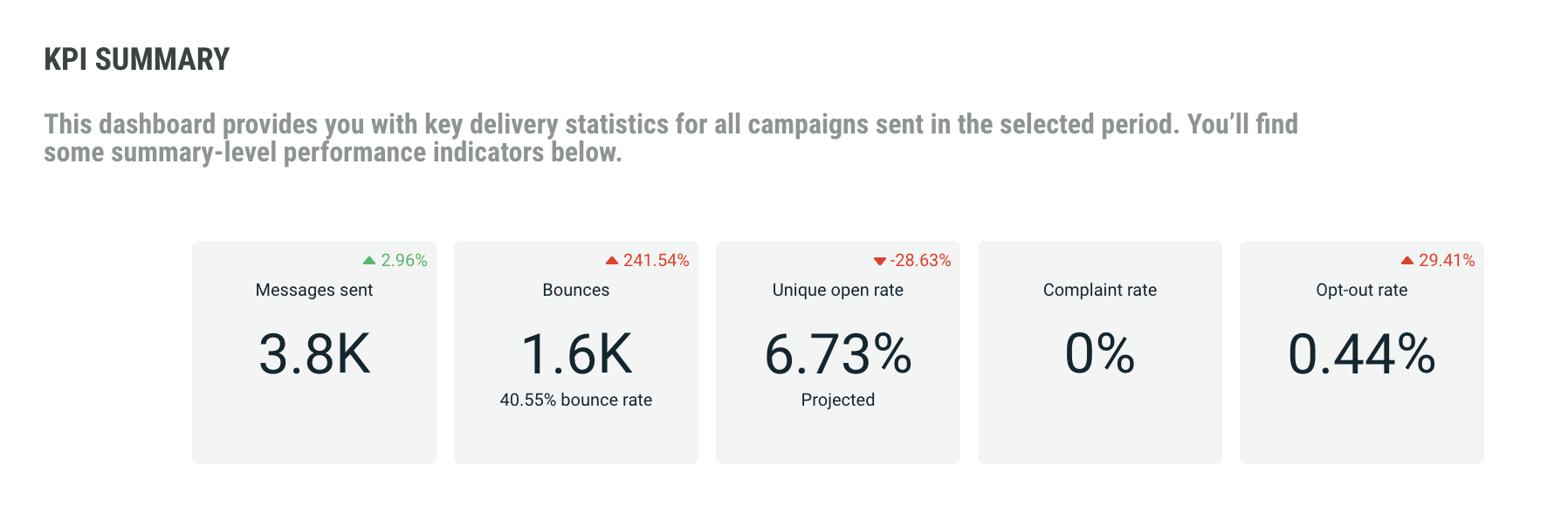
The KPI Summary report shows key delivery statistics for all campaigns sent in the selected time period. It includes:
- Number of messages sent
- Percentage of messages that bounced
- Percentage of projected opens. This is the unique human open rate as a percentage of recipients whose opens or non-opens would be visible. This means recipients using Apple MPP are excluded from the projected open rate
- Percentage of messages that generated a complaint by the recipient
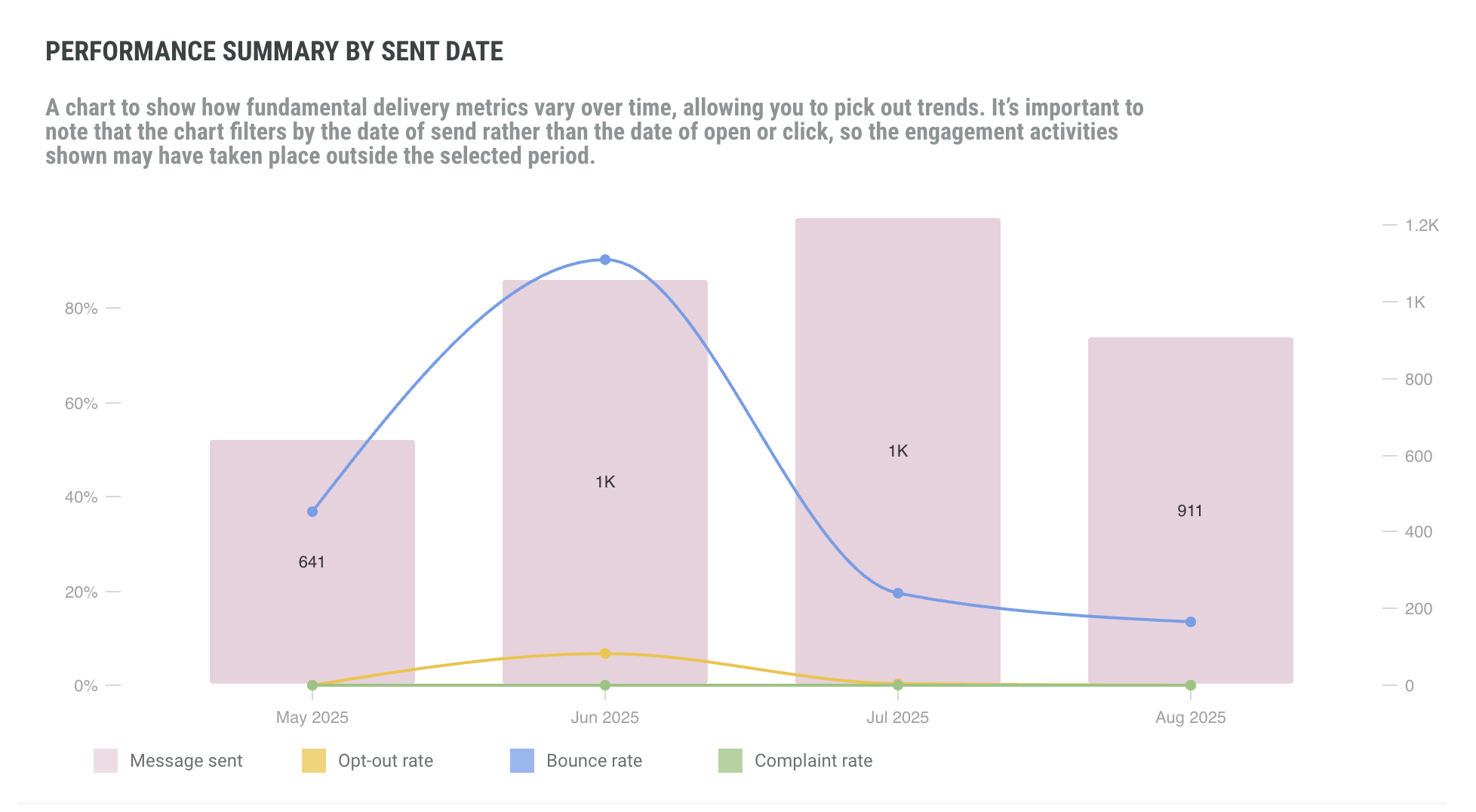
In addition, in the Performance Summary By Sent Date report, you can consult delivery details over the selected time period, and easily follow the evolution of bounce rates, opt-out rates and complaint rates.
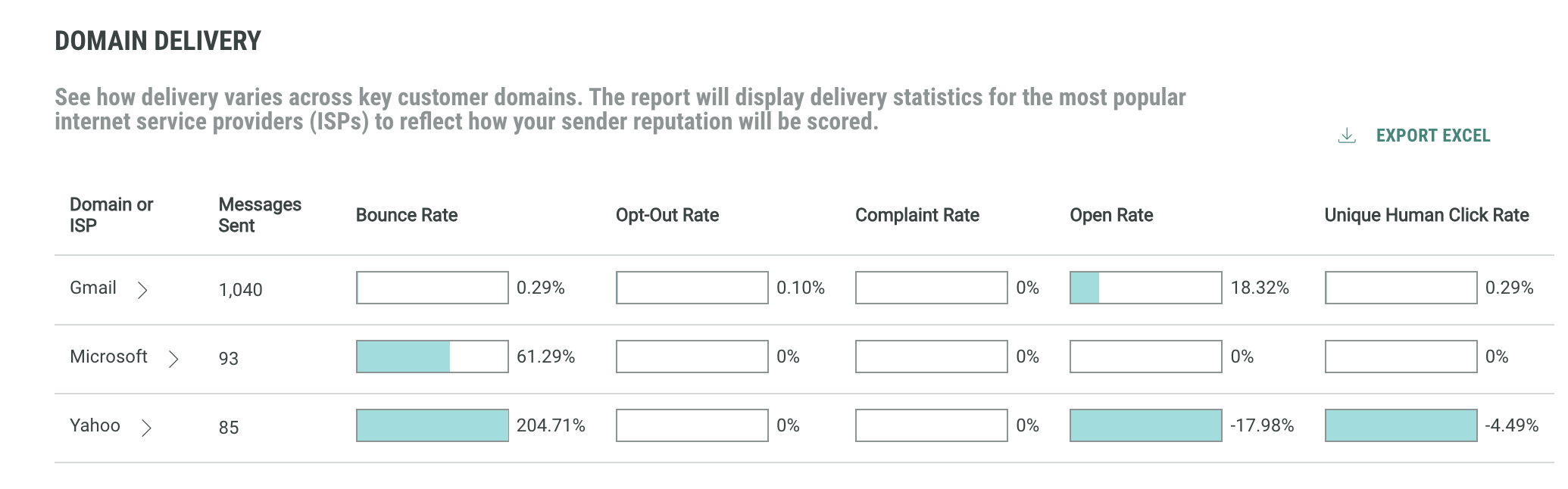
Next, the Domain Delivery report shows delivery numbers for individual ISPs. This allows comparing delivery numbers for key customer domains.
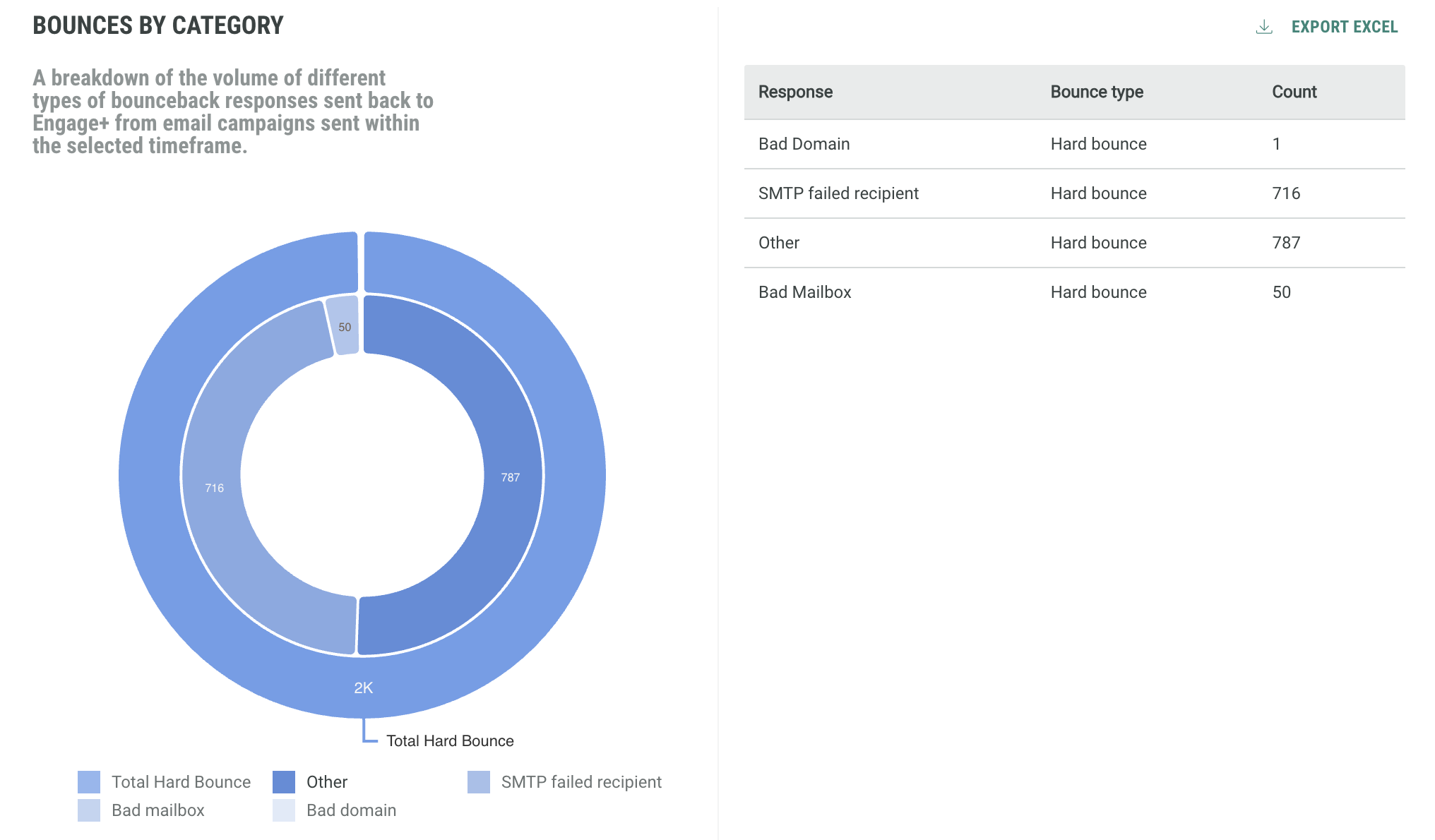
Also, it is good to know what the main reasons are for bounced emails. A dedicated graph Bounces By Category splits up the bounce information per type of bounce (bad domain, inactive mailbox, spam related, routing errors, etc.)
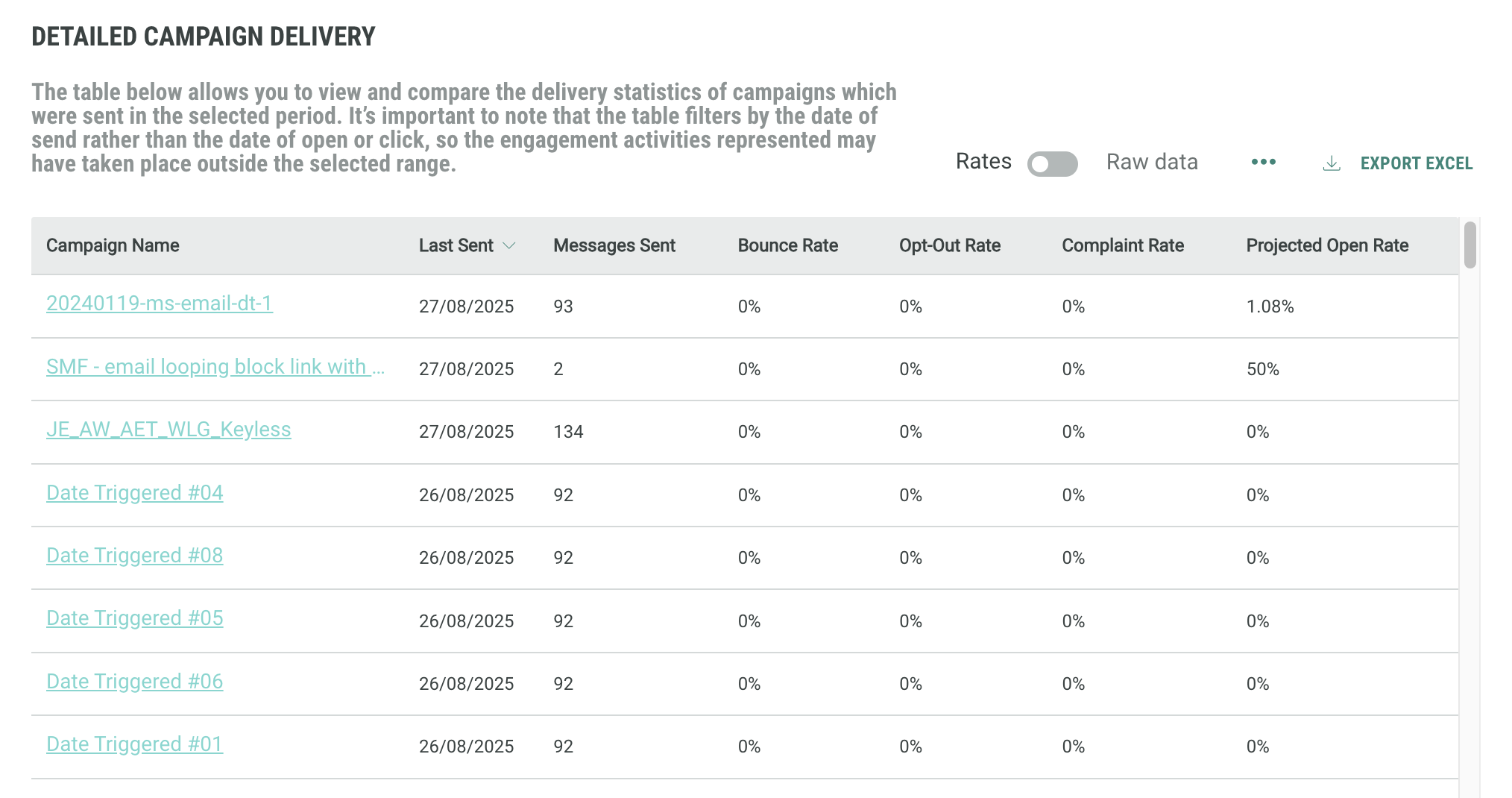
Lastly, you can also find delivery details per individual campaign. This allows you to compare the different campaigns and detect issues. Use the toggle on the right hand side to switch between viewing the rates and the raw data.
From here, you can click through to see the Real-Time Analytics for the selected campaign.
Links report
The Links report focuses on human and non-human click interaction, providing totals for the selected time period as well as an evolution over time. For marketers, it is important to know how much interest is generated through their emails. They can obtain this information by looking at click interactions but filtering out the non-human interactions. Also, insights on how these interactions evolve over time can provide valuable information for future campaign planning.
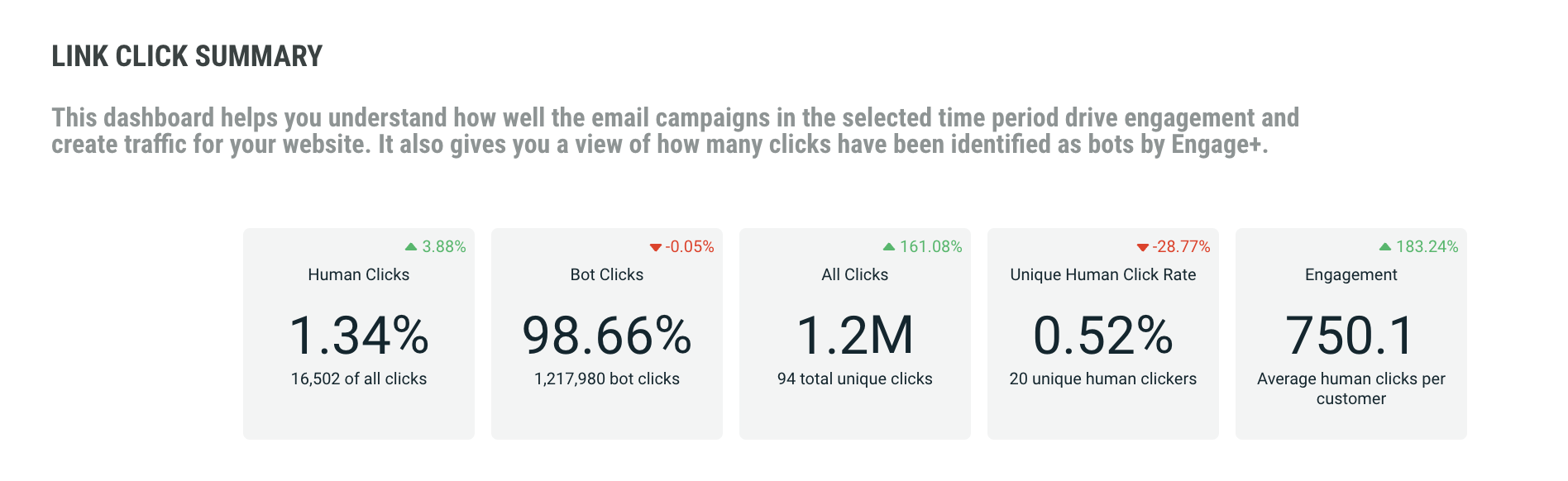
The Link Click Summary report provides insights on how much engagement and traffic your campaigns are generating over the selected time period. The following KPI are provided:
- Percentage of human clicks
- Percentage of bot clicks
- Total number of clicks, including human and bot clicks
- Percentage of unique human clicks
- Average number of human clicks per customer
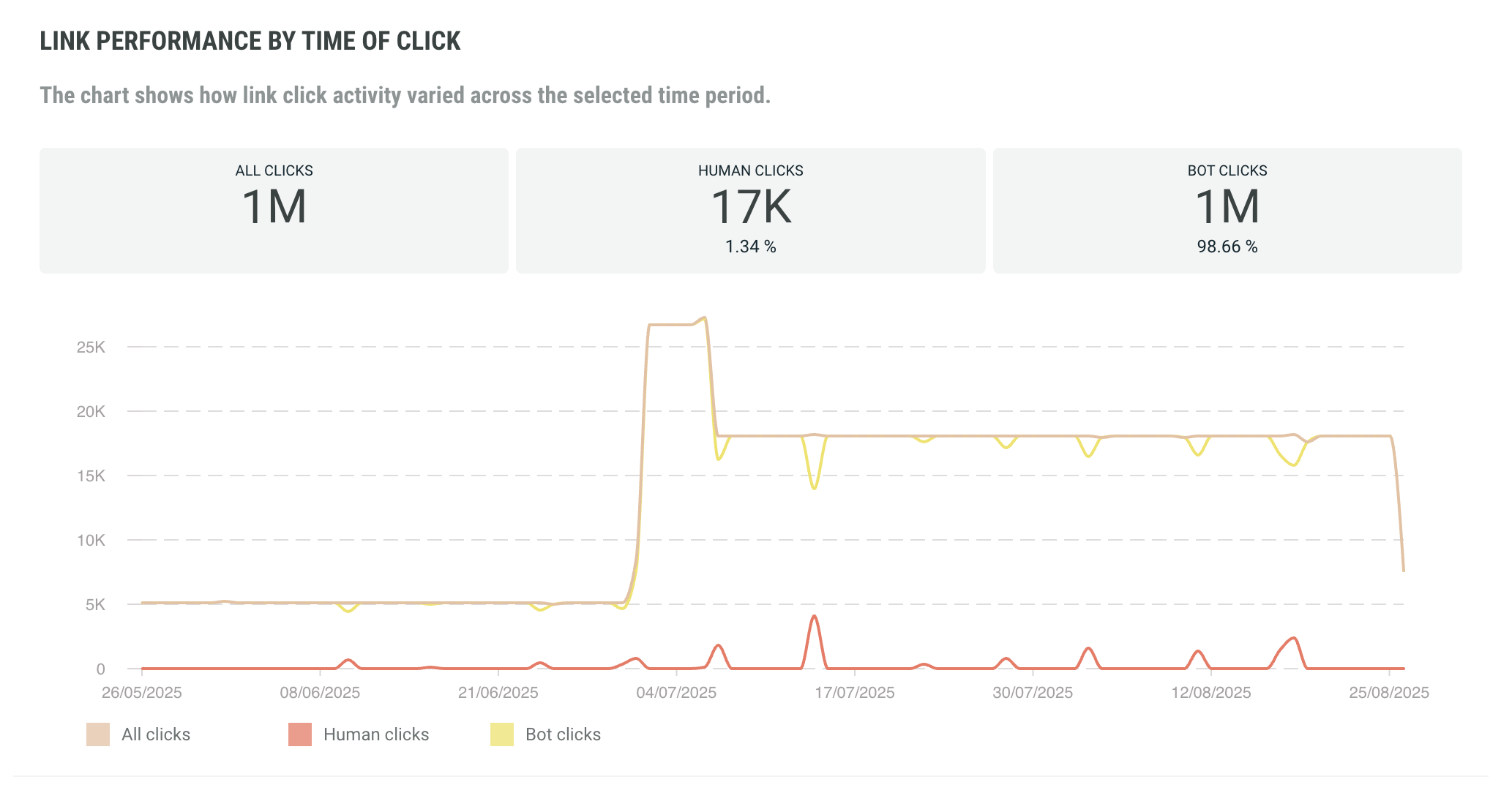
The Link Performance By Time of Click is a time line of click activity, showing how click activity varies over the selected time period. Human clicks, bot clicks as well as the total number of clicks are included.
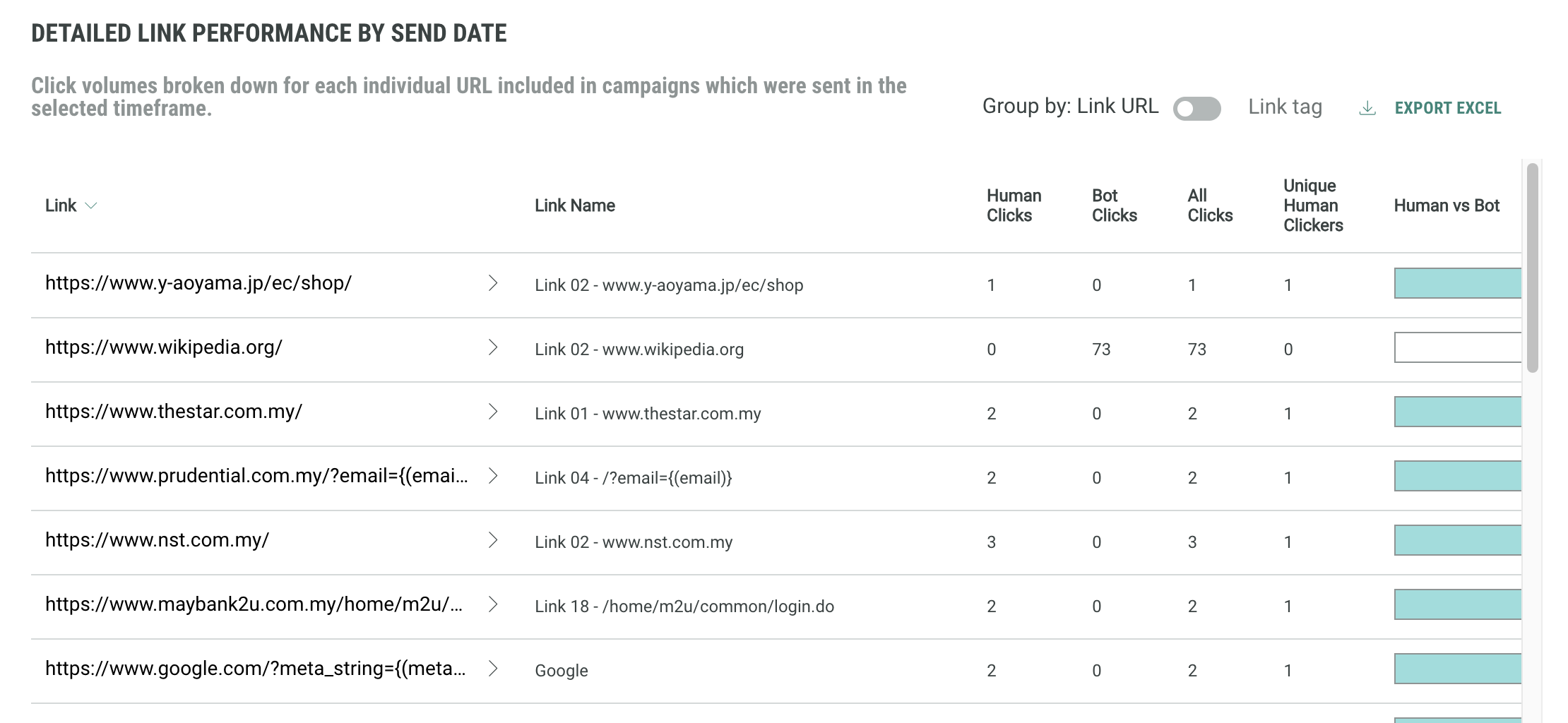
If you are interested in click behavior for individual links, the table view Detailed Link Performance By Send Date is provided, showing per individual link the number of human clicks, non-human clicks, total clicks, unique clicks, as well as the human vs bot ratio. You can click on the arrow to view further details on individual links when the links are grouped by link URL or tag.
Realtime report
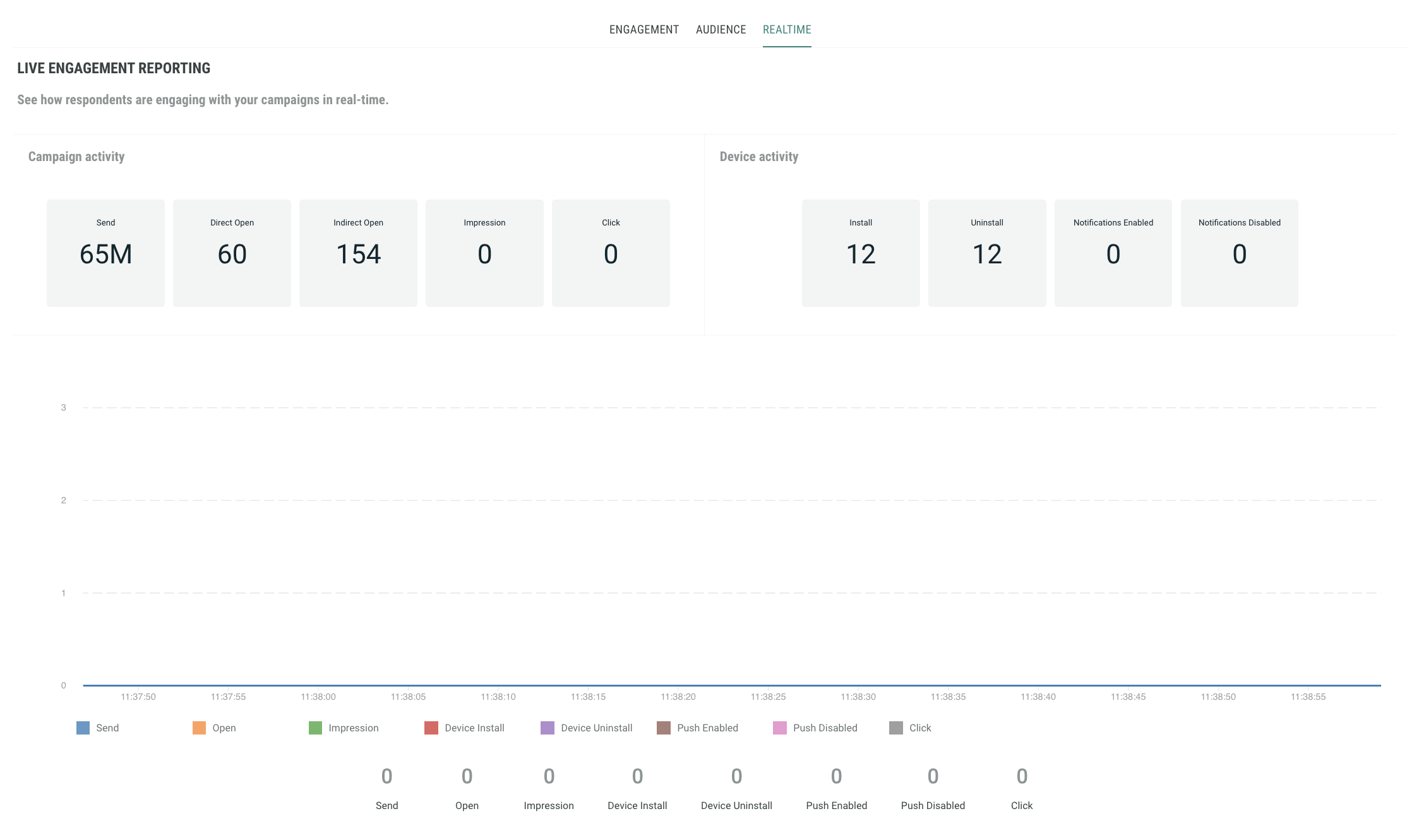
This report provides live engagement reporting (emails sent, opened, clicked, impressions, unsubscribed) and shows how respondents are engaging with your campaigns in real time.
The graph is continuously evolving within a time frame of less than a minute.
Audience report
This report provides an insight to how your audience responds to your campaigns to help inform your marketing strategy.
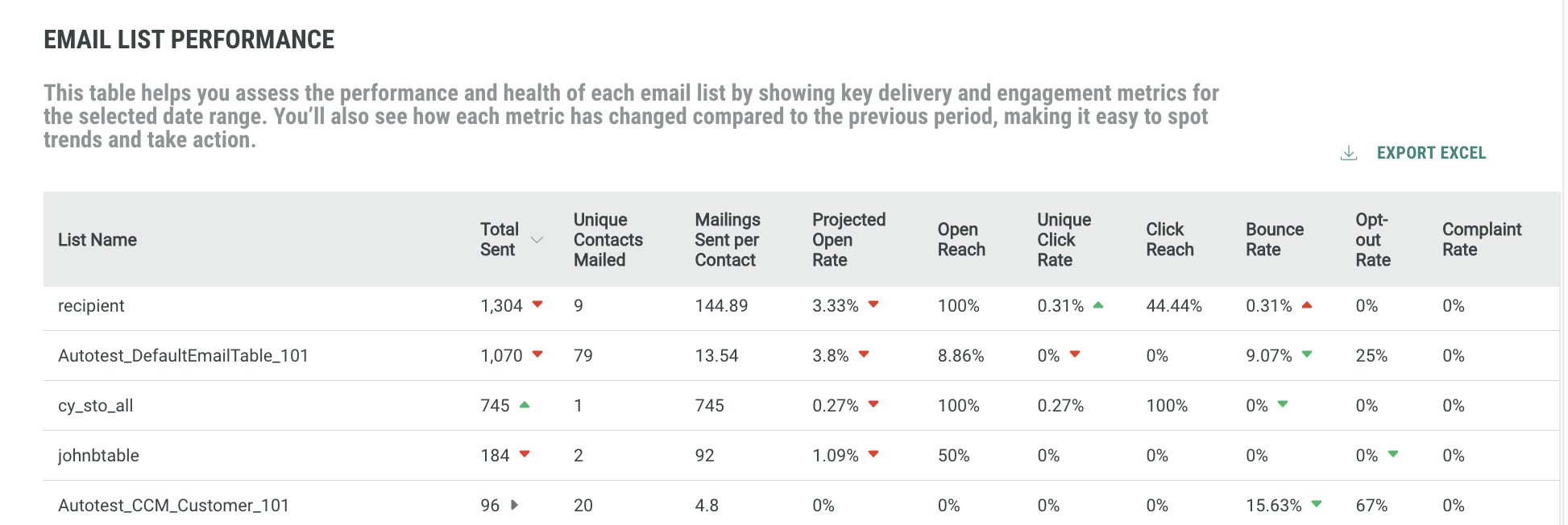
The KPI Summary report provides general KPI over all campaigns, such as:
- Total audience size: number of distinct contacts who received at least one message in the selected period
- Sends per contact: average number of messages sent per recipient
- Click reach: percentage of the audience who clicked at least once
- Opt-outs: number of opt-outs registered from messages sent during the selected time period
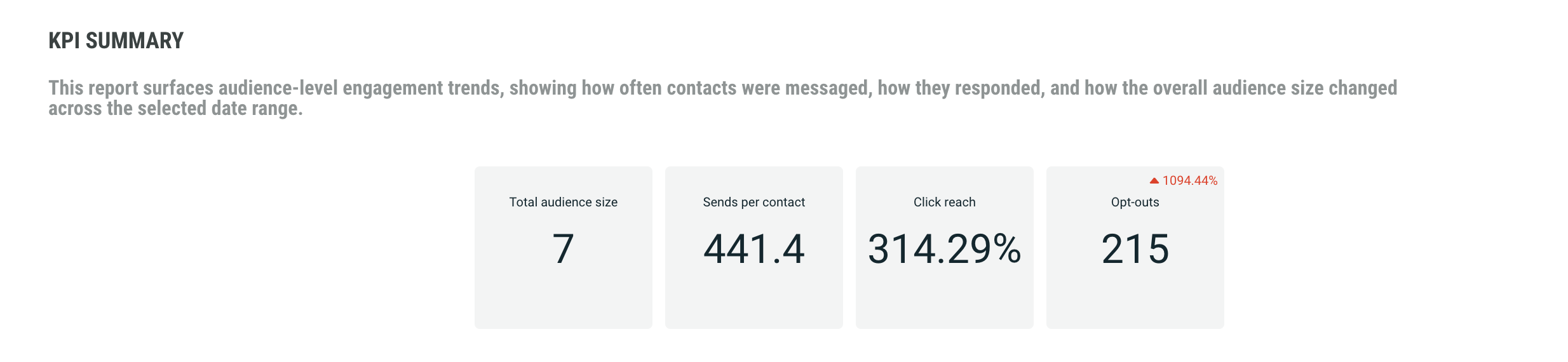
The Messaging Fatigue graph shows the frequency of messaging trends alongside engagement rates, so you can make informed decisions about whether to change send cadence.
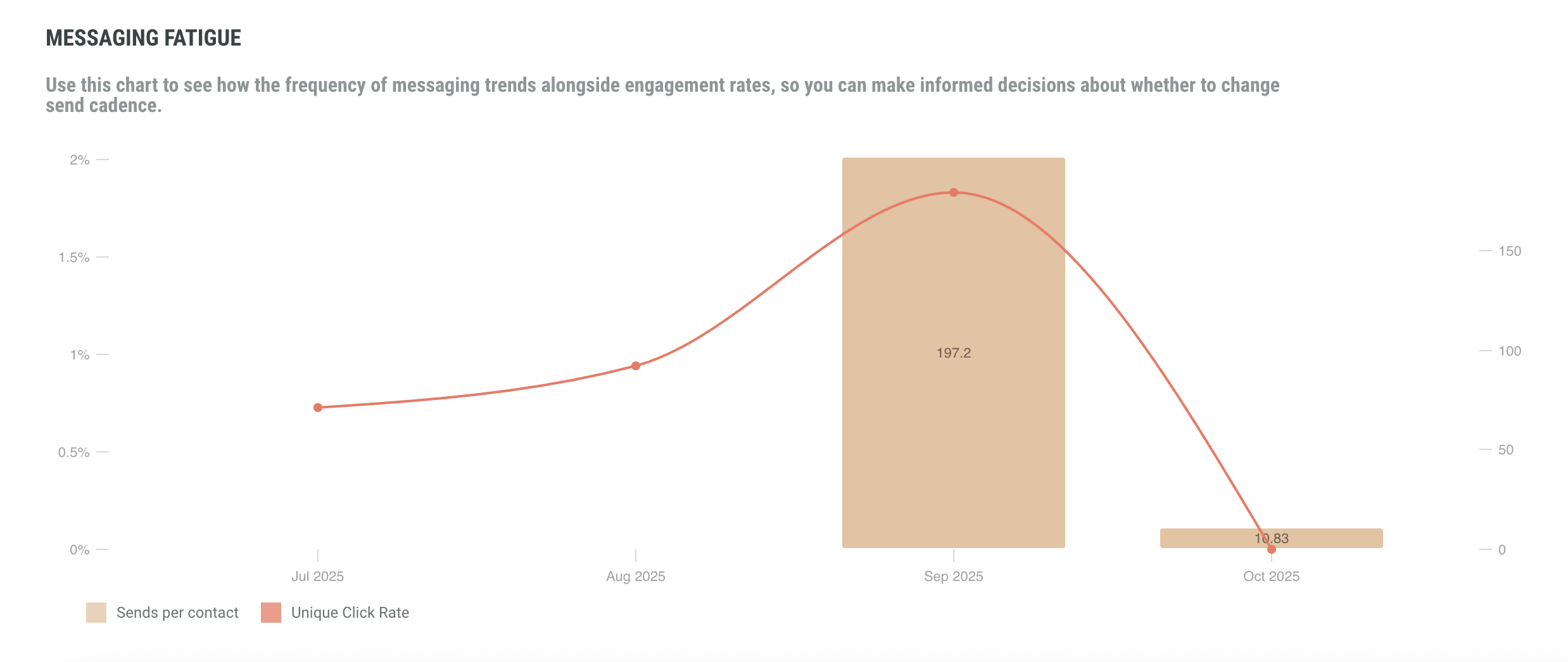
Use the Monthly Active Users report to understand engagement trends, this area chart visualises the total number of unique contacts messaged each month and how many of them clicked or opened (human only). The view supports trend analysis of audience reach and activity levels over time. Use the drop down to toggle between viewing Opens and Clicks.
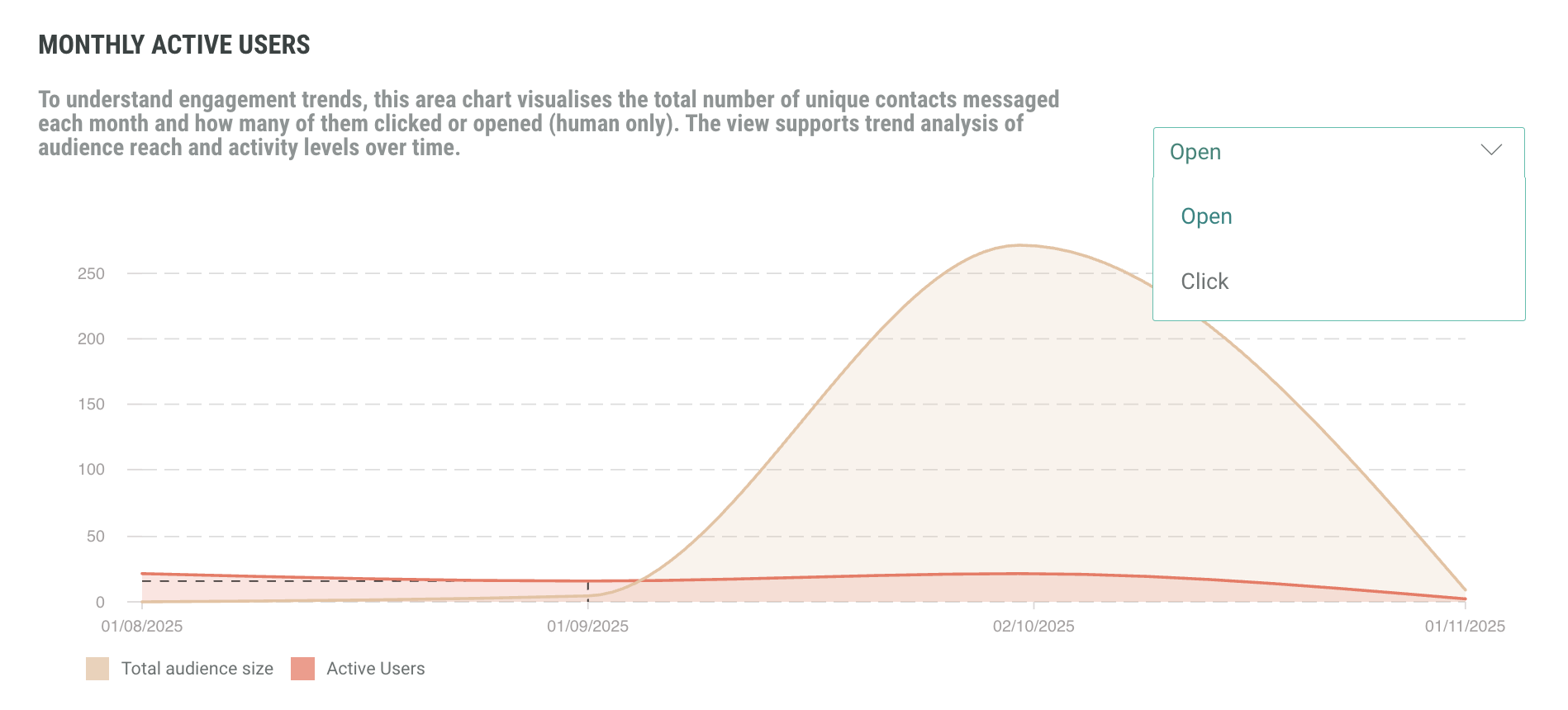
The Email List Performance table helps you assess the performance and health of each email list by showing key delivery and engagement metrics for the selected date range. You’ll also see how each metric has changed compared to the previous period, making it easy to spot trends and take action.
Geography report
Are your campaigns doing well in one region and not in another? Should you change your approach for specific regions where engagement is low compared to others? The Geography report allows you to compare engagement over the different countries.
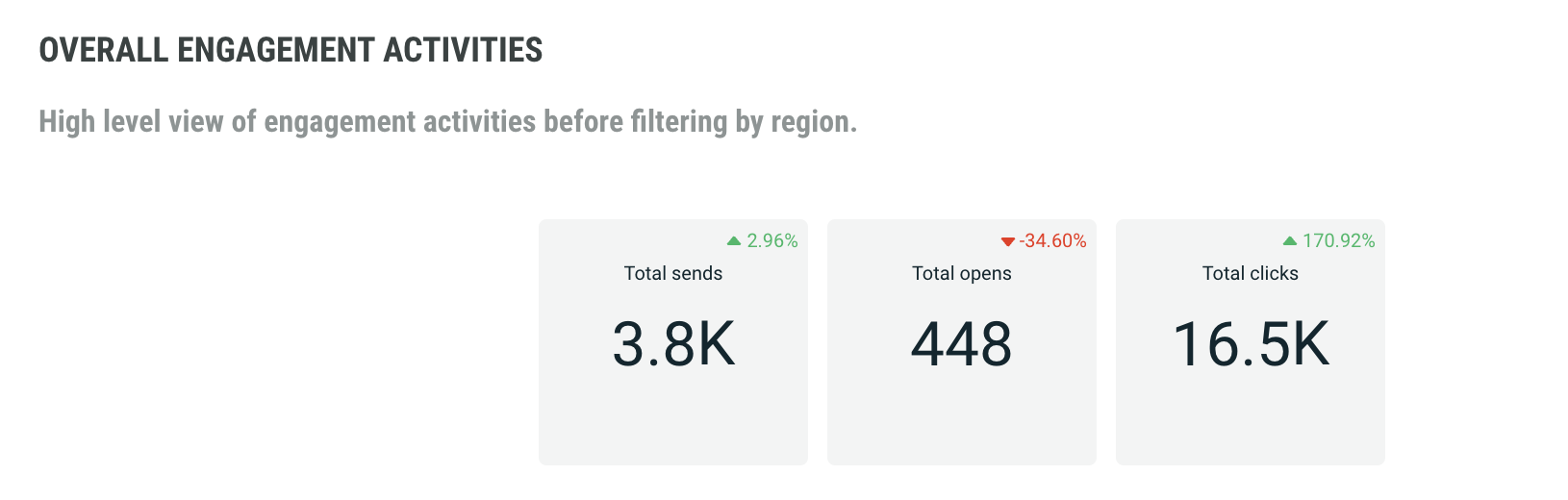
Overall Engagement Activities is a high level view of key performance indicators across all regions. It includes total sends, total opens and total clicks.
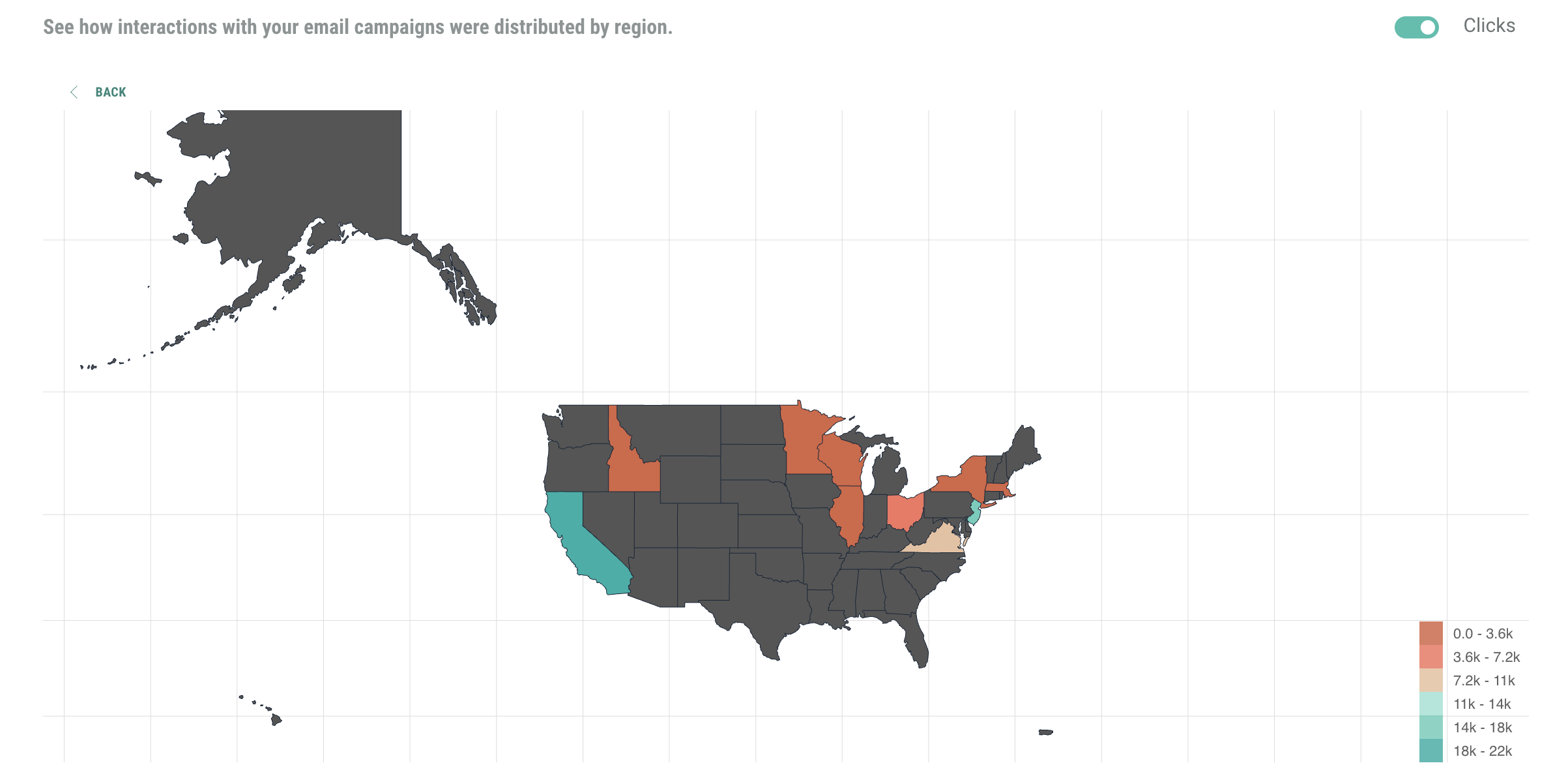
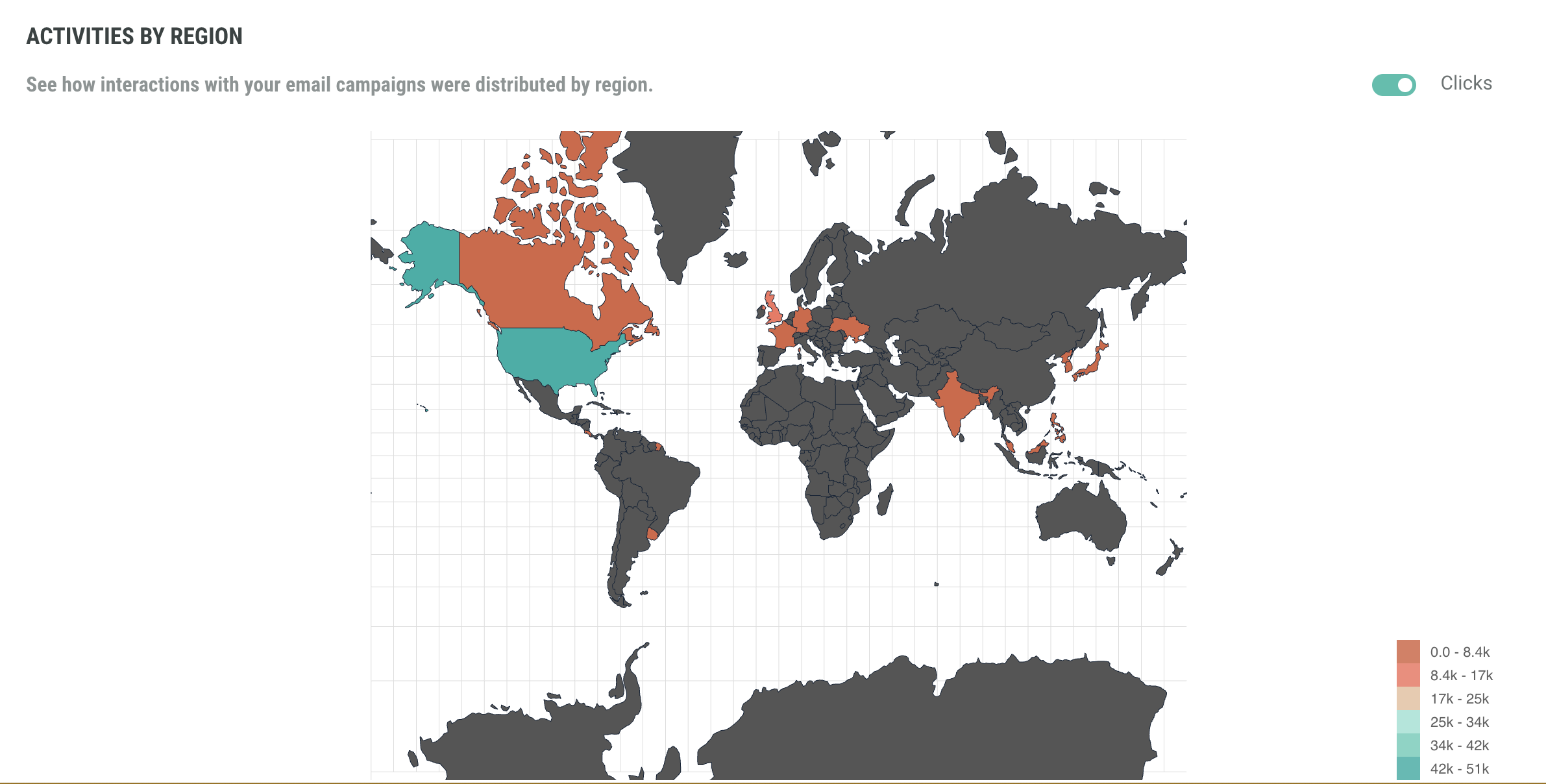
Activities per region shows a color-coded map with the distribution of engagement statistics over the different regions. This provides quick insights on what regions are performing better than others.
The table Detailed Activities By Region provides key performance indicators split up per region.
For example, click on the United States entry to see the numbers for the individual states within the US.
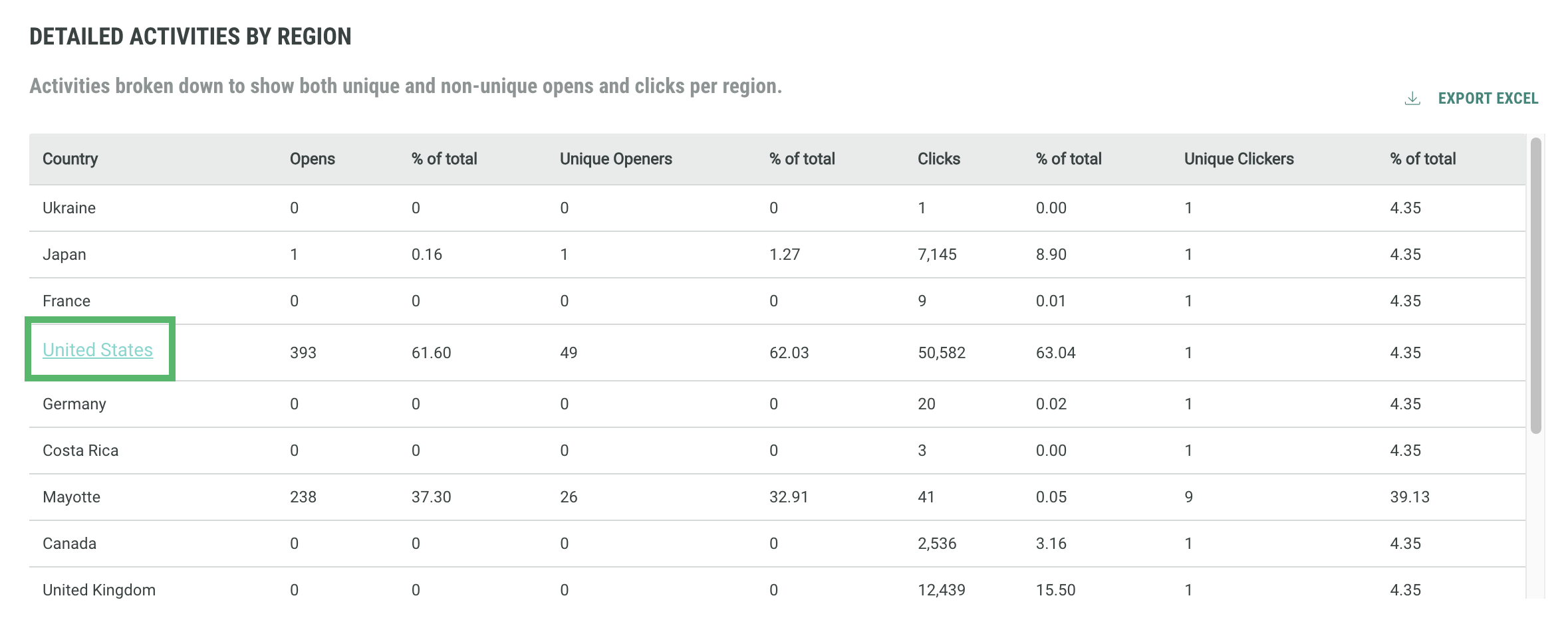
This loads more detailed map of the United States in the space above.